Monday, June 6, 2022

Gratitude: On Receiving Bowdoin College’s Common Good Award

President Rose, Trustees, members of the Alumni Council and McKeen Center for the Common Good, fellow honored guests, friends, family, classmates, collaborators and co-conspirators.


It is with stunned humility that I stand before you today and gratefully accept Bowdoin’s Common Good Award.

When this winter I received a FedEx envelope from the College delivered to our island address, I was gripped by a familiar fear.

The College had finally uncovered some bill I’d not paid!

This is comical in retrospect – I graduated 39 years ago. I know the College finance department is much more efficient than that…

Yet my instinctive fear points to who I am, where I come from, and the ambivalent relationship I’ve had to the College for much of my life – all of which make this award that much more meaningful to me.

I am deeply moved by, and grateful for, the College’s recognition of my lifelong passion for the arts, and of their power in my work in cultural and economic community development  in Maine. In particular, in our more isolated rural areas and with our young people. Work I have undertaken, in large part, as a way of returning to the State the great privilege of the excellent education I received here. And everywhere I go in this expansive state, I am awed by the number of Bowdoin alum I encounter serving the common good. It does seem as if the beautiful Offer of the College works deeply in us. With so very many deserving of this recognition, I am especially humbled by  this award, one I look forward to sharing with my many peers in service.

Having my my work recognized and amplified in this, the 50th anniversary year of women at Bowdoin, is a huge honor and a tribute not only to me but to the many women who’ve worked collectively over these 50 years to make so much change possible.

I love the word common. I am proud to be as common as they get.

I am a queer, working class activist  whose heritage is only two and three generations deep on this continent. My grandparents had sixth and eighth grade educations; my parents were awarded high school diplomas; and it was hoped for if not expected that I would take the next step, to college.

An important part of being common is being PREVALENT: there are many of us. We are not exceptional, and that’s a good thing.

Yet there were not many of me when I arrived at Bowdoin in 1979. My family was always deeply uncomfortable when visiting. I and several of those here today, and many more, quickly learned to create commonality across differences to collectively battle our shared oppressions –boarding school students to financial aid kids, CIS gender to queer, black women to white women.

My best work and biggest successes have always occurred in the creation of these commons – the free, open, public spaces shared by all – and their communities. I am honored to have been one small part of the greater collectives that launched Bowdoin’s Women’s Resource Center, now the Center for Sexuality, Women, and Gender; that created Opera House Arts and restored the historic Stonington Opera House; that is currently forming the Cultural Alliance of Maine to strengthen the state’s commitment to its important indigenous, immigrant, and local cultures.

Every time we come together, for any reason – a meeting, a movie, a musical performance, church - we create new community: unique gatherings of commoners. From each community, we learn something. From each, we are able to launch collective action for healing, for hope, to advance our common good.

Our work is not done. Too much violence, and great and painful inequities, continue to exist and threaten to divide us. And so I will leave you with this. In 1980, one of the first books we purchased for the Women’s Resource Center was lesbian poet Judy Grahn’s The Common Woman Poems. In it she wrote a verse that appeared on many of our walls and T-shirts for years to come, a poster of which has since wound up in the Library of Congress. “A common woman is as common as a loaf of bread,” Grahn wrote.

“And she will rise.”

Let us keep rising. Let us commoners keep gathering in the commons.

Thank you.


Wednesday, May 25, 2022

Are We Too Late to Adopt "Community Rules"?

An annotated tax map of downtown Stonington, ME.
The pink dots represent properties owned by non-residents.
 

In 2020, the COVID-19 pandemic accelerated and exacerbated a trend that was already well underway: the sale of our communities to investors and "non-residents" -- people who do not work here, vote here, or live here year round.

The map above shows the impact on the village of Stonington. Only 30% of our downtown properties are owned by residents. And only 15% are commercial enterprises. 

That means 55% of downtown properties are owned by non-residents. And outside of the village, 80%+ of the total Stonington shoreline is the same.

Some call this gentrification: when wealthier people from other areas, in search of a higher quality of life, gravitate toward beautiful, end-of-the-world places formerly populated by people there because of birth or work -- including artists. Because property values and incomes are higher where they originate, their interest in and purchase of local properties in communities such as Stonington drive real estate values beyond the reach of local workers.

Change is inevitable and those who engage with the same place year after year know the glories and the heartaches of these changes. The questions are: can we direct and influence change with community values and actions? Knowing what history has taught us: how could we do this differently? How might incoming property owners show more respect for preserving the cultures and places where they want to spend time, too?

Because in some ways, we might also consider some of these changes as a kind of ongoing colonization. After all, the generational White islanders who make up a majority of today's Deer Isle residents replaced the indigenous people who stewarded and used the natural resources for more than 2,000 years before we asserted our own White European cultures.

Here's a suggested, partial checklist of "community rules" for everyone's consideration -- feel free to add to and share this!

  • Get to know a place and its people and economies before purchasing property. Buying property in bidding wars "sight unseen" on the internet is no different from being part of a gold rush. And just like previous gold rushes, it's destructive to a place's natural and cultural resources. 
  • Our community is more than your financial investment. We live here year round, through the cold and muddy grind climbing March hill. We raise children here and struggle to maintain our local schools. We work here and what we harvest and make creates a sustainable year-round community. We vote and volunteer as firefighters and ambulance drivers; we serve on committees and participate in the municipal process, moving the gears to make a livable, sustainable place that can welcome visitors such as you. 
  • Don't put your own desires above the community's needs. I know this is a tough one given American individualism, but...well...it's not all about you and what you can afford and to what you feel entitled because you happen to have the cash -- or the real estate to attract the cash. Feel blessed by and grateful for your privilege. We didn't allow our "rusticators" of the past to gobble up all the real estate so that workers had no places to live, and they in turn didn't rent their seasonal cottages to others to churn in and out of every three days as if this is a party boat. Love Deer Isle-Stonington? Buy a non-winterized cottage and spend five months here, volunteering for nonprofits while you are here. Or establish a regular rental from a year-round person who needs the income to pay their property taxes. Already doing these things: thank you! Remember that you already own a place and vote and work somewhere else: you don't need to own here, too. 
  • Be of service, make a positive impact. If you've made it through the first three bullet points and are still determined to buy, sell, or rent a place, consider how you can contribute -- with your time, expertise and heart, in addition to your wallet -- where the community has the greatest need. Some communities add transfer fees to real estate sales to fund needed community projects. Or if you buy and are only going to visit for two weeks of the year, consider renting it for the other 50 weeks to a year-round, working community member. It's not as sexy or as flush with cash as being an AirBNB host, but it will eventually help you to become an actual member of a real and beloved working community.
  • In the meantime, the Stonington Economic and Community Development Committee is running a Short-Term Rentals Task Force with the objective of lessening the negative impacts some of these are having on our communities. We meet monthly and welcome your input to econdev@stoningtonmaine.org.

    Our island is suffering from the top-heavy impact of a new wave of colonizers. Our workers have no places to live and are cut off from the source of their labor and passion on our working waterfront. Our natural resources and infrastructure -- such as Stonington's Sanitary and Water districts -- are stretched beyond their capacity. Our schools don't have enough students to be sustainable, and our teachers and nurses can't find housing. Our beautiful village is dark and empty for great swaths of the year.

    What can we do differently?

    Sunday, May 15, 2022

    Losing Our Nonprofit Religion: Bad Boards and Misunderstanding JEDI

    Myles Jordan and Kirsten Monke, two members
    of the DaPonte String Quartet, in a 2012 concert 
    of new music produced by Opera House Arts
    at the Burnt Cove Church in Stonington.
    Photo by Karen Galella.

    This weekend's news about the hostile board takeover of the Friends of the DaPonte -- ousting the founding musicians as salaried employees and changing the organization's name and mission while waving a false flag of "diversification" -- is, I can only hope, the straw on the camel's back of nonprofit board culture gone seriously awry.

    The nonprofit sector, and the "culture of philanthropy" that supports it, has been -- like the "fourth estate" of the press -- an important leg of the stool that is the U.S.'s socio-cultural economy.

    We all need it to be functional.

    The sector's purpose -- to fill unique charitable needs -- is intended to take the capitalist rule of transactionality off the table: experiences and services are not measured solely on attendance and earnings; community relationships are more important than transactions. In the U.S., the sector, like government, exists to serve the common goods of our communities, filling gaps in public services that in other industrialized countries the government often provides more of -- including the arts.

    And in the nonprofit cultural sector, some organizations are appropriately leading the way in doing the work of JEDI -- justice, equity, diversity, and inclusion -- centering the voices and work of those who have for so long been excluded, as well as adopting new ways and teams of cooperative, equitable working.

    Yet over the last 40 years, in parallel with the "Reagan Revolution" move toward "supply side" economics, we've experienced an increasing amount of dominant, capitalist culture values and strategies creeping into the nonprofit sector, until today our common goods and charitable purposes are awash in a flood tide of transactional programming (services and events without relationships) and egocentric leadership (building individual resumes and prestige). Boards are too often comprised of affluent people suffering from the entitlement of "father knows best" because they've been successful in the capitalist marketplace, and they bring those unexamined, dominant culture values with them.

    Nowhere is this more starkly apparent than in the recent actions of the Friends of the DaPonte board.

    The DaPonte's uniquely charitable, laudable, and purposefully specific mission was to advance equity for artists. The founders knew that to truly practice and present their craft, strengthening communities through access to live music and music education, they had to create a stable income base. Remarkably, over 30 years they achieved this. 

    Now along comes an ambitious new Executive Director/composer and a board that misunderstands not only its governance role to steward the nonprofit's mission but how to pursue JEDI. The result: by changing the name and purpose of this nonprofit and firing the musicians as employees, they are stealing assets that don't belong to them and flying in the face of JEDI values.

    Diversification of programming is laudable and necessary. So are equitable pay for artists and good governance values such as respect, listening, relationships, artist leadership, and stewardship. 

    It seems clear the ED and board could not get the DaPonte to go exactly where they wanted them to go -- specific programming not being the purview of the board in any event -- so instead pulled the rug out from under them.

    The DaPonte are artists who created a nonprofit with a small, singular purpose to sustain their craft and their community impact. If, after discussions with them, the ED and individual board members remained dissatisfied, they had several options open to them -- notably recognizing they are in the wrong place and departing to start their own nonprofit chamber music series. 

    Instead, they've chosen the path of theft and disrespect, laying bare the damaging mechanics of inequitable governance run amok. 

    Let's hope this incident can, first, be over turned and secondly that it sparks the necessary conversations, awareness, and changes the nonprofit governance model desperately needs.

    #nonprofitmaine

    #governance

    #culture


    Thursday, April 21, 2022

    How Together An Island Can Sustain What Matters

    On May 7, all are invited to join a free, guided, 90-minute walk in downtown Stonington from 11:30 a.m. to 1:00 p.m.: "Pier to Pier: A Jane's Walk Through Time, Fishing, Quarrying and Culture."

    The Town of Stonington is hosting this walk as an opportunity for community members to engage with Stonington's history and also the serious current challenges with which the Town is grappling: sea level rise, fishing industry changes

    Who is Jane Jacobs, for whom this walk -- part of a series of walks happening around the world -- is named? Why is the Town of Stonington, along with its partners the Deer Isle-Stonington Chamber of Commerce, the Stonington Public Library, the Harbor Cafe and Maine Center for Coastal Fisheries, hosting this event?


    creative ways to do workforce housing


    Saturday, March 26, 2022

    D.C.: Cherry Blossoms and Heartburn

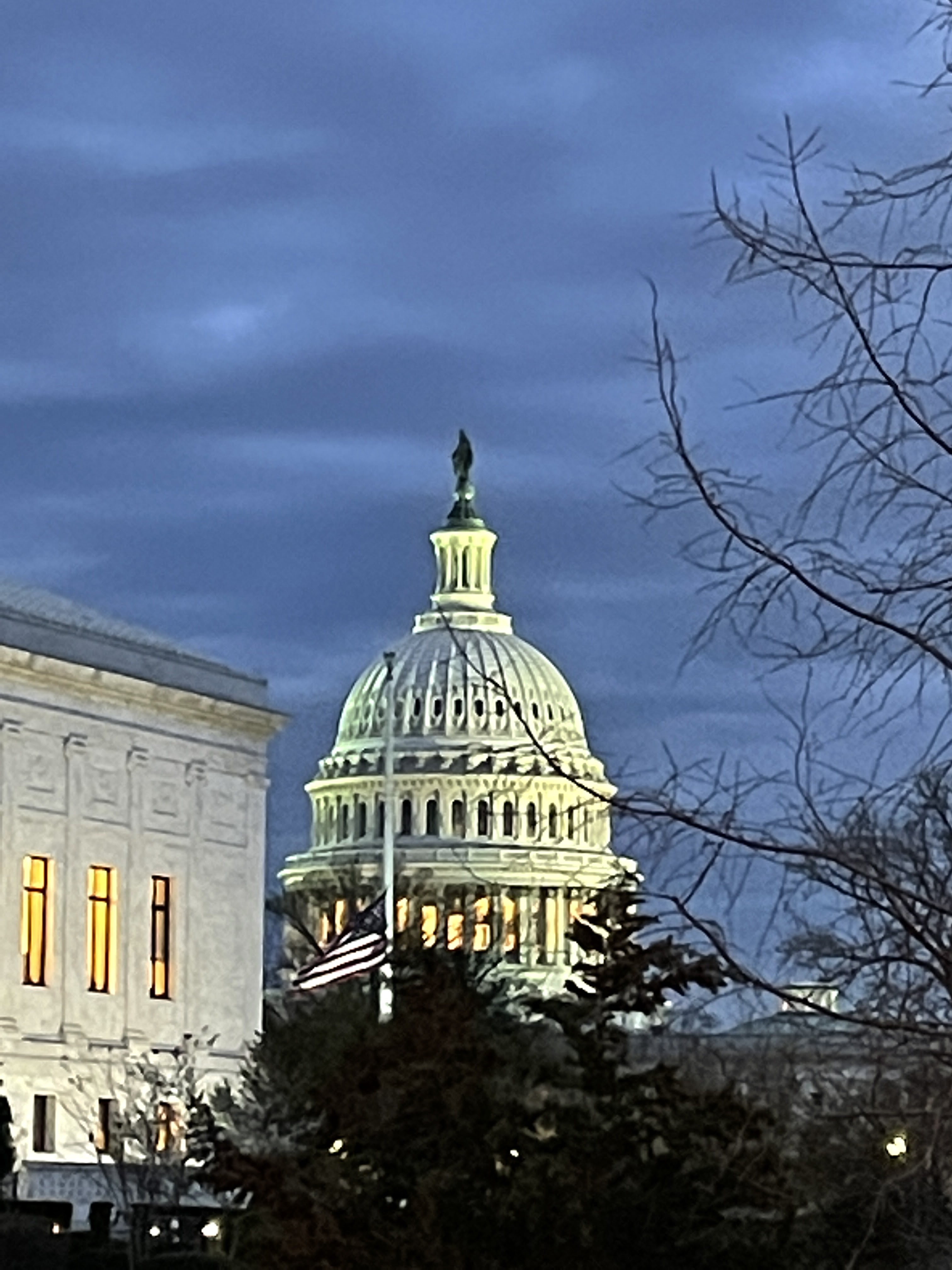
    First view of the U.S. Capital from aboard the Palmetto.

    I'm arriving in our nation's capital for less than 24 hours as I train my way back up the eastern seaboard. I'm feeling sad, somewhat disassociated, which is odd as I'm on my way home from a terrific visit with one of my oldest and best friends.

    It's the capital building itself. It sends a direct current through my heart, creating a sharp burn from the moment the crown of its dome pops into view.
    The cherry-lined shore of the Potomac.

    From Fredericksburg to Alexandria, VA, Amtrak's Palmetto line runs up the Potomac. It is a big river, wide and throaty brown, but not as long as Virginia's famed James River. With its headwaters in the western Appalachian Mountains beyond the Blue Ridge, the James -- originally the Powhatan, like those who lived here for thousands of years pre-colonization -- brought in ever increasing numbers of British colonialists and took out tobacco, the labor intensive and soil killing export that made the settlements, with the labor of enslaved peoples, economically viable. The James dumps into the Chesapeake at the large, protected harbor of Newport News/Hampton Roads: a place I've never been but know as the primary competitor for the New England sub- and ship-building Navy towns around which I grew up and still reside.

    D.C.'s fabulous cherries are in bloom along the Potomac, the Tidal Basin, and every street. Yet just as in my previous post about the desert, the burning pain in my heart vies with all this beauty for my attention.

    I'm a product of the school of American Exceptionalism: I was taught to believe and accepted as reality that the U.S. is different from other nations, that our values and political systems are unique in history such that it is our destiny to lead.

    A magnificent old cherry propped up outside the Library of Congress.

    I believed it about our country and, as a citizen of this country, about myself as well.

    I took off the rosy glasses about myself at 14, about the time when many, teetering on adolescence, do.

    My first muse and champion, my Grandmother Mary, had died several years earlier. Fourteen was the age at which I first quit the Catholic Church and understood myself to be a lesbian. None of this fit the radiantly perfect image of who I was intended to be.

    By 1975 I'd also had to adjust my rosy lenses in regard to the country. I wore a leather peace sign around my neck and had completed my high school prep watching the Watergate trials and Nixon's resignation.

    Yet still, my "city on a hill" syndrome of romantic nationalism persisted. Once it gets its barbed hooks under your skin, removal can be difficult and painful.

    In 1978, on our junior class trip to D.C., my first views of the Capital Rotunda, the Lincoln and Jefferson and Washington Memorials, the Library of Congress and the Supreme Court awed me with their grandiose aesthetic portrayals of our "uniquely" American values.

    Even the first Presidential election in which I was able to vote in 1980 -- with an apparently rigged Iranian hostage crisis, devastated cities and rampaging inflation working together to sink President Jimmy Carter, the most moral politician I knew -- didn't manage to put the final nail in a coffin that was almost but not completely sealed for me.

    There have been thousands of nails added since. And still, I held onto something -- can I call it hope? -- until January 6, 2021 and the assault of armed citizens on the Capital building in an attempt to overturn a legitimate election.

    Let's not kid ourselves. While the coverup of and gaps in the teaching of American history are very thorough, at some point most of us are forced to accept that a nation built on genocide, land theft, and enslaved labor is rotten at its core.

    What some of us keep hoping for -- followers of Martin Luther King, Jr. and others -- is that our efforts for change will create opportunities for redemption.

    I'll keep working for #justice, for #love. But the sight of the capital dome, and the memories of armed hordes assaulting Capital police desecrating symbols of our democratic ideals, is now a shot of direct current that burns my heart.

    The rear of the Supreme Court: "Justice the Guardian of Liberty."


    #americanexceptionalism
    #powhatan


    Thursday, March 24, 2022

    Beauty and Suffering, Starsky and Hutch: Matches Made in Heaven

    A velvet creosote bush two miles from the U.S.-Mexico border.

    Deserts are miraculous places. Constant reminders of how much suffering exists within and alongside beauty.

    The southern borderlands' dry clear light and relentless winds tattoo us, exfoliating potential tears and sweat from skin. Sitting quietly, we become the busyness of acorn woodpeckers, yellow-rumped warblers, lesser goldfinches, Mexican jays, a whole host of diverse hummingbirds. Jumping chollas, saguaros, flowering yuccas and creosote create vast expanses and palettes of color.

    These dualities seem even greater here in the U.S.-Mexican southwest, what Gloria Anzaldรบa identified in 1987 as Borderlands/La Frontera. Subtitled The New Mestiza, this book was and is iconic to me as a queer, adopted person. It is a layered work of prose and poetry, dream and theory and identity, built on Anzaldรบa's life as a Chicana, lesbian, activist and writer to remap the ways we understand false physical "borders" of nation into the psychic and cultural worlds in which we are alive together (see the new critical edition released in 2021 by Aunt Lute Books. I was lucky to interview Gloria in 1989 when I wrote about this book for a special edition of TRIVIA, A Journal of Ideas I co-edited with Lise Weil.).

    First day in the borderlands, driving our rented gray Dodge Challenger "muscle car" we call "The Ghost" and jokingly referring to ourselves as Starsky and Hutch, we were pulled over by Border Patrol. The car does have a certain "look" that might in some minds contradict our own "look" of old lady white privilege. Our GPS had us turning in circles as we emerged from a birding preserve in a canyon where, it turned out, BP had been running an "immigration operation" for a couple of weeks.

    They searched our trunk. 

    My generous partner in crime (Hutch) with "The Ghost."

    This beautiful, painful, arid place, where the Sierra Madres meet the Sonoran Desert, is a good place to find myself mid-Lenten season. According to the christian bible, Lent represents the part of the liturgical year in which Jesus fasts in the desert for 40 days, at the end of which, starving, he is tempted by the devil. Satan does his best to lure Jesus with the rewards white America loves best: reputation, power, possessions.

    Birdwatching in the desert during Lent: intentionally stripping away distractions from suffering and reflecting on the beauty of our connections. What are your primary distractions? Social media? Food? Love and affection and sex? Work? Wealth? Privilege? Accumulation?

    Like the vermillion flycatchers darting ceaselessly above the San Pedro river to feed themselves, or the hummingbirds who eat all day long, work is both my primary distraction and connections.

    A vermilion flycatcher, one of many perched along the San Pedro.

    It's as impossible to ignore the green-striped border patrol trucks at the mouth of practically every wash, the proliferation of state troopers in the medians, as it is the brightly colored birds. Law enforcement is heavy here, where the U.S. has built walls and fences across the frontier over which indigenous peoples once migrated freely. Where we attempt to keep out those suffering from the violence and starvation of our own banana republic policies and actions.

    Nationalism, punishment, greed, a lack of mercy -- these are the sins of our national culture against the world we've been given to steward and to share. As a nation, have we failed these crucial tests?

    And still, like birds: how can we keep from singing. For justice. For love.

    #vermilionflycatcher

    #riparian

    #lafrontera

    #borderlands

    #newmestiza

    #newblogpost


    Thursday, March 17, 2022

    The Northeast Regional, Part II: Freight Trains and Junk Yards

    American automotive wasteland, as seen from the Palmetto.

    "The consequence of the projection of national sins, and specifically racism, onto one region is a mis-narration of history and American identity. The consequence of truncating the South and relegating it to a backwards corner is a misapprehension of its power in American history."

    --Imani Perry
    South to America: A Journey Below the Mason-Dixon to Understand the Soul of a Nation

    It's still dark in NYC when I board the Palmetto for South Carolina.

    The light emerges almost painfully slowly over the New Jersey marshes and petroleum plants.

    By the time we hit Philadelphia, the car fills up. I am one of a small handful of White people on this train of 90+ souls headed south.

    It's a 14 hour trip. I chose the railroad over flying for several reasons, the most important of which is that, simply put, flying has one of the biggest negative impacts on our environment.

    Commercial air travel accounts for 3 to 4% of U.S. greenhouse gas emissions, and increasing demand for flights is outpacing efficiencies.

    Yet still we feel, as White Americans do about so much, that our time is more valuable than the planet.

    Off the soap box and onto the train! I'm on the train. I'm on the train. I'm still on the train, 15 hours later. Georgia O'Keefe said about her paintings, "Nobody sees a flower really; it is so small. We haven't time, and to see takes time - like to have a friend takes time."

    I'm on my way to see friends. Traveling, like all else, suffers from (White American) demands for immediacy.

    We are delayed outside of Richmond, first by a freight train -- Amtrak runs on heavy rail lines for this route -- and then a medical emergency, requiring a wait for EMS services before resuming. Again north of Charleston by a second freight. Freight owns these tracks.

    American freight, Richmond, VA.

    Another reason I chose the train is that flying swiftly over landscapes has always felt to me like an unnatural way to travel. My body misses participating in the geographical changes in color, topography, and climate that occur when we move across hundreds of miles.

    The differences between Maine and NYC, or NYC and Charleston, SC are significant both geographically and culturally. They spin out on the other side of the glass as well as on the inside of the train. Freight trains marbled with graffiti. Flat, rolling farmland already dressed in bright spring green. Shadbush in bloom. Richer, warmer skin and vocal tones.

    It's a pretty grim weather day, sporting heavy, low-hanging clouds that mute these shifting tones. By Fayetteville, NC rain splatters the windows.

    You know that old saying about being on the "wrong side" of the tracks? Facts are being alongside the noise, vibration, and detritus of freight train tracks does not make for optimal locations, so when you're on the train you get a good look at the hidden underbelly of American culture, the places we live and work that you don't see on the internet.

    If you've never questioned overconsumption and throw-away consumerism in the U.S., take the train south and keep your eye on the landscape.

    In North Carolina, acres upon acres of automotive junk yards spool alongside the tracks. I am astonished, a little fascinated, saddened realizing I've not considered the fate of this centerpiece of American consumerism.

    We have junkyards in Maine, too. They can be part of the re-use economy. I've prowled several of them years ago, when parts were more interchangeable and accessible to standard humans: gas caps. Doors. Mirrors. Fenders. Rocker panels. It's the scope, the broad expanses of these tumbled fields of our automotive detritus nestled along the tracks that shocks me.

    Where will your vehicle end up when you are ready for a new one?

    How much time are you willing (or able: still a privilege) to take to visit friends and family?

    Will the changes in the ways the pandemic has helped me to see the world more slowly take root more largely in our cultures?

    #autohell

    #soulofamerica

    #imaniperry

    #slowtravel

    #georgiaokeefe

    #newblogpost


    Wednesday, March 16, 2022

    The Northeast Regional, Part I: Salt Ponds and Fog

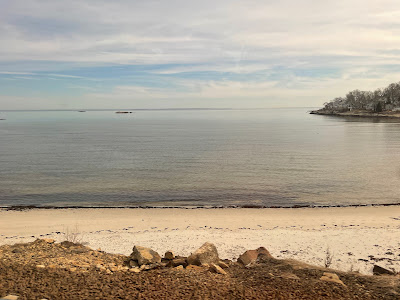
    The southeastern CT shore as viewed from
    Amtrak's Northeast Regional.

    I'm on the Northeast Regional from Boston to NYC. First time in two+ years of pandemic time. The Ides of March. Fingers crossed nothing goes wrong and I'll have no rationale -- say, a nuclear war started by Russia in Ukraine -- to run home prematurely.

    This train service humps its way down the New England seaboard -- South Station, Back Bay, Rt 128, Providence, Westerly, Mystic, New London, Old Saybrook, New Haven, NYC. It rides the rails of the geography of my youth.

    Boarding, I succumb to instinct and get a seat by the left-hand windows. As we run from downeast to southwest, these face the coast and the tracks run right along the shoreline.

    I've driven down to Boston from Maine and already, by southern Maine, the coast has softened and by the time we get to to the salt marshes and broad rivers of CT it appears to me to be almost velvety in color, hue, and form. There is something so inviting and welcoming to me about those lengths of salt grass and cat tails and sand, the flat, calm, warmer horizon merging seamlessly into sky without the familiar border of granite teeth.

    I get curious around Westerly RI. Even though I grew up on its beaches and in its restaurants and bars, house sitting here for my high school English teacher -- and even though, at 15, I was arrested here -- I realize I know little if any of its meaningful history. What I do know: that Stonington and Westerly high schools have one of the longest-running Thanksgiving Day football games in the nation (Bears vs. Bulldogs) -- that I think we never won during my tenure there?! -- and that there was a large Italian population (of which the cops were particularly comprised, at least in our urban myths).

    When I look it up, I'm surprised and even a little delighted. Like where I now live, Westerly was historically a granite town -- maybe thus the Italians, as in Stonington, ME?! Not only that, but Westerly granite is known for its pinkish hue -- just like Deer Isle, famous for its pink tricolor.

    Yet even more delightful are the salmon: “The Pawcatuck River flows on the western border of Westerly and was once renowned for its own species of Westerly salmon, three of which are on the town's official seal."

    Its own unique species! We knew the river only as a state boundary, one we crossed fluidly and with regularity. It's short, only about 15 miles long, and flows into Little Narragansett Bay.

    And the salt ponds. It's a wonder any of us survived weekends as teen agers driving in this area during the 1970's: drinking, smoking weed, driving through the inevitable fog. Driving into trees and cement block houses, going through windshields and losing too many lives.

    But those beautiful large salt ponds, three in all, "serve as shallow, reef-like pools whose outer walls form the long, white beaches for which the town is renowned." These carry the names the land's original inhabitants bestowed upon them, and flow from my mouth in a round, familiar way that makes me homesick. Weekapaug. Misquamicut. Maschaug.

    White America. Always driving into the fog, crashing, continuing on.

    #StoningtonCT
    #NortheastRegional
    #Westerly
    #Mystic

    Tuesday, February 22, 2022

    When Live is Live, and Why Live Matters

    Lydia Diamond's adaptation for the stage
    of Toni Morison's first novel.
    My partner and creative collaborator and I ventured back into the world this weekend, taking in a live concert and two live theatrical productions. Huzzah! Each was magnificent. Our souls, our skins, our beings vibrated with the songs and words of others.

    Let's talk for a moment about the power of "we all breathe the same air."

    Let's let out a sigh of relief for the ability to do this safely, and for those who have ensure that: the scientists and their vaccines, the Biden administration and its focus on distribution and relief.

    Let's humble ourselves -- just for a moment! -- in the sweet, anti-American mythology that each of us as individuals does NOT exist in our own pod of self-sufficient, bootstrapped being, but rather is dependent upon everyone before us and around us for who we are.

    COVID, a potent symbol of this dependence, remains out there and we still want to reduce and halt community transmission and the variants it allows to develop.

    We also want to heal the damage caused by social isolation.

    We want to heal the damage to our hearts and souls by two years not experiencing live art together.

    A fascinating new play at the
    Central Square
    Theater in Cambridge.
    With luck, the pandemic has caused more U.S. residents to be aware of the elemental, crucial role live performance plays in our hearts, minds, souls and communities: in our shared humanity.

    Truly, our crisis in culture -- the arts and humanities -- had been already building steadily in this country for decades pre-pandemic. TV's and even radios beamed entertainment directly to our homes long before the internet, eroding our need to venture into the dangers of the public domain.

    Yet the performing arts, unlike TV, are not "just entertainment." When we are live in a room with others, we are not merely on a one-way road, consuming what is transmitted to us; or even in a two-way or multiple player super highway of electronic gaming. We are exchanging breath with the performers and other audience members. We are participating in the creation of that performance and experience.

    The Isabella Stewart Gardner
    Museum: the privilege of 
    creating one's personal abode as
    lavish performance-art-to-be-
    experienced.
    In fact, the role culture plays in our continuous development as human beings is a happy "withdrawal from utility," a delightful counter to the increasing transactionality and monetization of all things in our society: "art and thought are forms of activity that have no immediate end." (1) This is, of course, also why a liberal arts education is such important preparation (i.e., not "training) for the world of work and citizenship -- but that is a separate post.

    I'll close this one by further referencing my "main woman" of political theory and philosophy, Hannah Arendt. In her essay, "The Crisis in Culture" (1968), Arendt argues that art is political: not in the ways it might speak directly to social justice and change but precisely because it is not a commodity and therefore requires us to gather in the commons where we must accommodate the perspectives of others.

    More on the importance of "the commons" -- or the polis -- anon.

    #ArtNotEntertainment

    #StopConsuming

    1. Julia Reinhard Lupton (2014) Hannah Arendt and the Crisis of the Humanities?, Political Theology, 15:4, 287-289, DOI:  10.1179/1462317X14Z.00000000085

    Sunday, February 13, 2022

    My Life as a CNA #4: Our Fascinating Stories

    Like many of you, I've become a little obsessed over the last few years with the mysteries presented by DNA connections and expanding Ancestry family trees. Like an Advent calendar, the little square photos of the digital tree open into unexpected narratives. There's so much we do not know even about those genetically related to us. Even those just a single generation removed.

    And of course for me the mystery is doubled by my adoption. So I've got two trees going, with multiple collaborators: my beloved family of adoption, and the far more mysterious French-Canadian immigrants for whom I can thank my genes.

    But the truth is the folx to whom we are actually related are only one surface of our multifaceted, glittering stories. I've yet to meet a single human whose story doesn't surprise and fascinate me. 

    On my last day of clinicals at the hospital.
    I'd just successfully fetched and learned how
    and why to operate this Bladderscan machine.

    Stories are one of the especially great aspects of being a nursing assistant. CNA life could, I guess, be called the opposite of glamorous (as many of you have pointed out in emphasizing it was fine for you as an entry-level teenager, but good to leave in that youthful past!) or well-rewarded. What CNA life IS is skilled -- the more you know about human psychology and the body, the better off you and all your residents will be -- AND an on-the-ground, direct caretaking profession that most often serves those with the least among us: the increasing number of U.S. citizens with dementia and its related diseases who end up in long-term residential care centers (i.e., nursing homes) because that is what our government safety net of Medicare and Medicaid will pay for.

    My mom and...not my dad.
    An unnamed soldier.
    How we grow old and die is, sadly, very much about economics: which perhaps offers a more humane rationale on our "run-for-the-riches" U.S. dominant culture? I'm not going to conjecture further on this here; but I do know that everyone deserves to age and die with dignity which, for a majority of people, would be in their own homes. But that's not often how it comes down if you get to the end of your life with limited resources; and as 55 million Baby Boomers are expected to be diagnosed with some sort of dementia over the next 20 years.

    As nursing assistants, we get to spend more time than any other professional with residents as we assist in feeding, toileting, bathing, grooming, ambulating -- and listening, and storytelling. The majority of folx in our care have been through many decades filled with experiences: childbirth, the deaths of spouses and children, school, travel, work, the challenges and diseases and traumas of poverty, sexism, racism, homophobia and more. Each one has a unique story so that by the end of every shift I feel I've been living in a new patchwork quilt of colorful, intriguing lives.

    H. is 94 and tough as nails with the staff. But she looks like my grandma, and she is sweetly gruff with me. Her next door neighbor suffers from schizophrenia and bites and kicks and...is the staff favorite. Across the hall is a woman who has lived for 40 years off the grid and is now subject to the constant background noise of TV. In the skilled nursing wing, a man on hospice remains a voracious reader and paints images of lobster boats. His neighbor, only 66, is a former half-miler and confined to a racing wheelchair with early onset Parkinson's. On another wing is a 54-year-old disabled by obesity and a stroke who tells me, repeatedly, how difficult aging is (I didn't tell her my own age!). She's ended up here as a result of nowhere else to go and no way to care for herself; and is pretty mean with the staff out of her own lack of agency.

    They are all (including the mean and desperate 54-year-old) fascinating. I adore them all. And the stories of their lives, and how those shape their current responses and choices, enrich me with every shift.

    #CNALife

    #caretaker

    #mysteries

    #storytelling


    Monday, January 31, 2022

    My Life as a CNA #3: Love Not Charity

    The scrapbook my mother made for school when she
    was eight years old in 1931 in Old Saybrook, CT.

    When my mother was eight years old, in 1931, her assignment from some inspiring and resourceful classroom teacher was to create a family scrapbook.

    It's a remarkable document, captioned in my mother's youthful penmanship, replete with some of the only labeled photos of our ancestors I've found amidst bags and bags of curled and unnamed images. It includes a handwritten list of the genealogy on my maternal side, and photos of my grandmother's house where not only my mother and her two siblings but I as well were blessed to have grown up.

    My grandmother and then my mother held onto this priceless archive until my mother's death in 2014, although its existence had been long forgotten by the time of my arrival in the 1960's. I never saw it or knew of it until, after her death, I began to sift through the boxes stored in my mother's basement. The treasure of things not discarded.

    Each day I am at the nursing home, I am reminded of how much, and who, we throw away.

    Elderly people--similarly to, as is often noted, babies--require a great deal of love and caretaking. Many return to that undeveloped innocence where they no longer are able to independently perform their basic mammalian functions of toileting, walking, and eating; nor the more advanced aspects of our humanity such as speaking, singing and dancing.

    The biggest difference between babies and the elderly? Babies are our futures, reminding us that life is eternal even when our own is not. The elderly--our ancestors--lives are in the past. They remind us that our deaths are inevitable and coming quickly.

    Increasingly, in our White U.S. culture, elderly humans--because they are not rich in future-time--are becoming, alongside the poor, the homeless, the incarcerated--the expendable. We push them aside and into corporately owned, for-profit facilities because we have created a culture in which we have neither the resources nor the time to properly care for them in our/their homes. In some cases, we are forced to institutionalize them to ensure they receive the medical care they need in a manner for which the state will pay.

    Blessedly, there is a loving abundance of care and caretaking in nursing homes. I've witnessed how this work is a labor of love for the women and men with whom I have had the honor to serve during my training. I've watched in their faces, and felt in myself, the constant stream of emotions that loving and caring for the stranger elicits: it is rewarding, fulfilling, challenging, difficult, exhausting, and thankless work.

    And still, while we do not discuss it, we do not fool ourselves. We go home late at night or early in the morning anxious and worried, imagining our own futures. Like the CNA's who care for them, our residents ARE the poor: they are the ones on Medicaid and Mainecare who cannot afford assisted living or private in-home care. They are the definition of the Greek word elachistoi: "the least of these" as it appears translated in the gospel of Matthew 25:40--you know, one of those key parables where Christians are told "...whatever you did for one of the least of these brothers and sisters of mine, you did for me..."

    The literal meaning of elachistoi is “the smallest or most insignificant ones," or, in another manner of speaking, the expendable ones.

    What I've noticed in the nursing home staff, and in myself, is that our very often invisible, forgotten caretaking for these elachistoi is not some type of romantic idea or charitable act. It cannot be. It must not be.

    For they are us. 

    Sunday, January 30, 2022

    The Blessings of Fragility


    I went to bed feeling blessed, with the wind roaring and the cold, cold snow still falling after a delightful blizzard dinner of roasted chicken, brussels, and glazed carrots. In other words, our power held!

    How lucky we are to be warm, to be together, to be fed. There are too many who are alone tonight; who are cold tonight; who are unhoused tonight; who are unfed tonight. It really just takes every one of our efforts to inadequately try to be sure those with the least among us are cared for. We are blessed, too, to have that work.

    And I awoke feeling our fragile and temporary it all is--and how this is at the root of our blessings. When we can hold it and not fear it (thank you, Thich Nhat Hanh). When we can love it and not have it make us angry. Especially in a nation in which anger seems often to feel like a birthright to the White settler-colonialist culture.

    With the power still on, we watched the Sundance Award-winning film CODA last night. CODA stands for Child of Deaf Adults. The movie is a somewhat traditional, quintessentially "American" tale--a young woman from the working class fishing community of Gloucester, MA, overcomes all obstacles to attend a music conservatory for college--but it is beautifully done. The fishing details, the sense of place, are evocative if, as-ever, romanticized. There is also a remarkable scene where the filmmaker allows us to experience what it is like to be deaf in a hearing world. But it was the 17-year-old hearing protagonist's deep connections to her deaf family, and the conflicted emotions she feels in leaving them for music school, that resonated deeply with me.

    I miss my mom and my dad. I wish I had been better able to cross the huge distances that developed between our lives as I came out, went to college, became an artist and an intellectual.

    My dad was functionally deaf. He didn't lip read or use sign language, but did have a hearing aid in one ear which allowed him to hear enough to get by. But he couldn't stand being in crowds: the background noise was just too much confusion for him. And, like the family in CODA, he could not really hear live music. And my mom, for a variety of similar reasons of brokenness, did not like to go anywhere without him.

    (c) 1987 Kathryn Kirk
    They delighted in each other, in us, and our small, tight family. Our world was very small. 

    Since my dad couldn't hear, they didn't attend all the concerts I was in nor any of the sporting or other events. As an adopted, queer kid wanting a bigger world, this just made me feel abandoned (although I could not give voice to that) and angry (to which I gave plenty of voice). 

    My understandings of their fragilities and vulnerabilities came much too late. We spent years disenfranchised from each other, with sparse visits. And then, as they were older parents, they began to become ill and simply needed our love and care in return. While I was able to provide some of that, I too often resembled the son in the Harry Chapin song with which I grew up in the 1970's, Cat's in the Cradle.

    Mae and Evert--like all of us, when we settle into it--were broken in their own ways. As mid-century White Americans, they were not married until their late 30's. Unable to have kids. One deaf and one with wayward eyes. First generation high school graduates of immigrant parents. And they had, and gave my brother and myself, many privileges as well--not the least of which is being White and educated in the U.S.

    And love. And perhaps most importantly, they gave us their frailties: blessings on which to base our own development of compassion, empathy, and love.

    #gratitude

    #love

    #blessings

    #frailties


    Sunday, January 23, 2022

    My Life as a CNA #2: Strokes and Insights


    This photo, from the mid-1960's, shows my maternal grandmother, Mary Urban Endrich, standing strong as ever in the magical flower and vegetable garden she kept between her house and ours -- the pink ranch in the background.

    I know this is the mid-60's because Mary is already somewhat diminished here. A giant of a woman in both personality and form, she began to have a series of small strokes -- today we would call them TIA's (transient ischemic attack) -- when I was four and five years old. The big ones that finally took her from us were in 1970-72; she was only 74 when she died, and I, whom she had taught to read and write and garden and work a farm stand, only 11. 

    Mary in 1961 at her full, pre-
    stroke size, greeting my
    arrival.
    The big strokes caused her daughters, my mother and godmother, to move her in with us. Fifty percent of the time she was in NJ with my godmother and her family, 50% of the time with us. She and I shared a bedroom, so at an early age I got a good look at the damage strokes can cause to our beloved people. Her inability to speak, her permanently contracted hands, her rapid weight loss, her shuffling gait.

    The majority of residents in today's nursing homes are those with some form of dementia or stroke victims. And the majority are women. Many of these can no longer independently perform their ADL's (activities of daily living) and require nursing assistants to feed, dress, toilet, and bathe them. A good many are confined to beds, unable to stand or walk on their own.

    As a family, we cared for Mary until her body quit. The body is a tenacious thing and, 50 years later as we have extended life spans, even more so now than then. We were also there full time to tell her we loved her, and to remind her of the good life she had lived. 

    In this way, we were also there to help her to die.

    As CNA's, we're here to care for every resident just like family. In the absence of family members, we toilet, feed, dress and exercise people in the last portions of their lives. Yet it is different today. There are nearly six million patients with Alzheimer's in this country, and within 20 years this number is estimated to rise to 55 million. Alzheimer's and dementia break the connection between a body and its memories.

    Can we know how to die when we cannot remember that we have lived?

    As a culture, as we've become increasingly disconnected from the natural world around us, the cycles of living and dying can feel removed from us. Watching a flower bloom and die, we are reminded of how temporary life really is. We all die so that others can be born.

    I still miss Mary every day. She is a huge part of who I am. Until her last breath she would point to me and say "the girl is good" no matter what I did or how impatient I was. Her love for and belief in me was no small thing to have. While I would have loved for her to live to see me go to high school and college as she wanted, I'm really glad we could all be there to help her die in love and dignity. And I hope that by caring lovingly for our many elderly residents who can no longer speak, or walk, or eat on their own that we are doing the same for them.

    #NursingHomeLife
    #CNALife
    #LivingAndDying

    Monday, January 17, 2022

    The Beloved CommUNITY

     "Holy One, help us to truly become the Beloved Community."

    Rev. Gerald "Jay" Williams, Ph.D., Union Church Boston

    in his invocation for the 52nd MLK Day Breakfast


    Every day is a good day to dance and sing in praise of, and to fight for, our common humanity. Especially as we annually honor the Dr. Martin Luther King, Jr.

    To truly become community requires UNITY. To build unity across our differences requires perseverance -- the type of stubborn, dogged relentless that can only be powered by our faith in and hope for a peaceful, just world in which all are perceived and treated with equal respect.

    Building unity is hard: we are all so different! And there is richness and vibrancy in our diversity. Too often, however, we make the mistake of holding onto our individualism to the detriment of the common good.

    Unity doesn't mean we all need to believe or say the same things: it simply means we have to believe enough in each other and our communities to let go a little bit of the individual selves to which we cling so tightly.

    So today, in honor of MLK: what will I let go of in order to create unity and strengthen our beloved community?

    #unity

    #belovedcommunity

    #MLKDay2022

    Saturday, January 15, 2022

    My Life as a CNA #1: Swifts Premium Meats


    My dad was a big guy.

    I'm talking the broad-chested, big armed, big bellied kind of working guy. The kind of guy who literally, early in his working life, could heave several hundred pound sides of meat up into the Swifts Premium Meats truck he'd been hired to drive.

    Then he got married.

    He wanted to be home, not out driving. He wanted to make a good salary in order to build his own home on land given to him and my mom by his mother-in-law, and to adopt some kids.

    My dad and his favorite "things" in the late
    1950's: his mother, his wife, and his Chevy.

    So he went to work as a machinist and sat at a work bench day in and day out with a loupe strapped to his forehead and machine oil covering his hands. By the time I came along in 1961 he'd got eczema, got fat, and dreamed of getting out. It took him another 10 years of drafting, research, and scheming about franchises and the great outdoors before he was able to invest his and a bit of money from his mother into the new development of a K.O.A. (Kampgrounds of America) campground in Mystic, CT, 25 miles away.

    It was clear that being a factory machinist was making him unhealthy. Like almost everyone in those days, he was a heavy smoker. And the weight he was gaining just felt inexorable to us all.

    My mother had a recurring nightmare, one she told me and my brother as little kids at the time, that as he was coming in the back door in the evening after work a murderer -- holding her hostage behind the door -- would shoot him. This was probably a lot more about her own fears than my dad's reality, but the message to her was that my dad was so big that death would not be able to miss him. She feared for his life, that his size would take him.

    And it did.

    I just had to confront my dad's life and death again, 20 years after he passed from complications of diabetes-caused amputations, in my first clinical shift as a Certified Nursing Assistant (CNA).

    I served three older, White male patients during my first shift. They all had diabetes, and all had circulation problems in their legs and feet -- just like my dad.

    When I walked into the first room, I could hardly stop staring at those so-familiar legs. If you're a severe diabetic, the excess sugar in your blood stream impedes your immune system while simultaneously causing neuropathy, putting one at greater risk for an all-too common and dangerous bacterial skin infection of the legs known as cellulitis. 

    This man's legs looked just like my dad's: swollen until they looked hard as newel posts, and a deep bluish red.

    I wouldn't be exaggerating if I told you I wanted to cry: for this man, who had already lost a few toes so that his feet functioned in more of a club-like fashion; and for my dad, who died in 2002 after having his second below-knee leg amputation resulting from uncontrolled Type 2 diabetes. Obesity is one of the major factors in the onset of Type 2 diabetes as it causes insulin resistance. And obesity in the U.S. is a systemic social disease -- not a personal one alone. 

    My next stop was to assist a very obese man with his toileting. Again like my dad, his weight-driven diabetes was creating infections and had made him unable to independently perform some of his key activities of daily living (ADL's in CNA jargon).

    My nursing partner and I took care of him that day, as we said, "like a king." The duty nurses loved all these patients: they knew them well. The gentlemen, like my father, were in and out of the hospital regularly, living long term with the impacts of their life choices.

    During my father's first hospital stay sometime in the 1990's, when they told him they were unable to heal the open wound on his foot that had been festering for months despite excellent care, he began to throw things at the nurses assigned to him. He was so angry that medicine was unable to fix a problem he knew would ultimately take his life.

    But the only one who could have fixed it was him.


    The Always Unfashionable Patriarchy

    The author in first grade circa 1967.
    As she grew older, she played football
    but chose not to see herself as intimidating.
    It's again unfashionable to talk about "patriarchy" -- if indeed it ever was, for a millisecond perhaps during the 1970's and 1980's, "in fashion."

    But damn, as I become an older woman stepping out of the hierarchies of power, I experience daily its continued and oppressive dominance as a player in our White colonialist racist culture.

    Patriarchy -- the hegemony of men over women -- is a cultural power structure and conjoined twin of capitalism because the hegemony of men over women has always, like capitalism, been about the power of property and power over the labor of those who create and cultivate it.

    Who's got it, who's not.

    What's annoying and frustrating to me these days are all the White men who conceive of themselves as "progressive" and talk-the-talk of diversity, equity, inclusion and change but whose actions still belie they are all about power and control. These defensive and offensive actions create a toxic environment of bullying, condescension, transactionality and ego-centeredness of the individual in which many of us know we no longer have to work, play, or live. 

    Just one example: within the last year, when I was onboarding a White man to a new position in a company I founded, he made a point of telling me he was aware he was "intimidating" due to his size. He claimed to have been a football player. Obviously a small one -- maybe a running back? -- as he was barely taller than I and I in no way found his stature "intimidating." 

    I laughed. I knew the goal of his passive aggressiveness: he wanted me to be intimidated. The same dude had rudely shut down another of the female founders during his orientation process.

    THIS is what the "great resignation" is really about. The pandemic made a whole lot of workers and even volunteers, including in the nonprofit sector, aware we don't have to put up with this as "assumed normality" anymore. No being chided or lectured or "merely" condescended to by male staff or board members. No placating privileged and entitled donors of any gender. No being disrespected based on one's gender, the color of one's skin, or one's age. No being underpaid for same. No falsely attending to the transactional when we all know the relational is what matters. 

    The pandemic, thankfully, forced many of us to break from the norms of White colonialist culture to belatedly realize that our families, friends, and relational personal lives are more important to which to attend than these priorities, values, and behaviors of a labor market constructed by White men to dominate, exploit, and justify their own inequitable gains. As one of the most important anti-racist documents in the arts stated it: we see you.

    Imagine walking through the looking glass and into a different world. A world in which the values that have been ascribed to the feminine -- listening, questioning, collaborating, cooperating, respecting life, the planet, and the ancestors just to name a few -- govern our interactions: business, political, and social.

    We can all, regardless of gender, walk through that mirror at any time. That's all feminism is: a choice. A choice of what world we want to live in, what values we want to promote, what behaviors we will tolerate. It's the courage and the privilege of saying "no" to terrible boyfriends, husbands, employers, boards and values. But we can't minimize the ramifications of saying no. They can be considerable: loss of income, loss of family, loss of prestige.

    Let's wake up to unity. Too often we don't see that the values we ascribe to "all we have" overshadow the more important values we give up in order to have what we do.

    #justsayno

    #EndThePatriarchy


    Monday, November 22, 2021

    When Everything is Weaponized

    Golden maple tree November Maine
    Where shall we end, those of us wanting to live in peace in this weaponized world?

    Let's not be fooled: weaponizing everything has another word when it is a strategy used by non-White people. 

    That word is terrorism. And terrorism is the environment in which we are now living in the U.S. -- and not as a target from foreign entities.

    Terrorism: ordinary individuals weaponizing their bodies, vehicles, or arms to achieve control and political aims.

    The news from Wisconsin this week has not been good on this front.

    Last night, a man drove his red SUV through barricades and into a holiday parade, killing, at last count, five people and injuring many more. Weaponizing his vehicle, as we've seen in Charlottesville and other incidents.

    This was not a protest but significantly in many ways a Christmas parade: and even if it were a protest, the response should not be weaponized by either individuals or the government.

    We allegedly have the right of peaceful protest in this nation. Of taking a knee whether on the football sidelines or the streets.

    But wait: that brings us to the second piece of news from Wisconsin. The verdict in the Kyle Rittenhouse case.

    If weaponizing our civic commons is legal -- i.e., everyone has the right to open carry deadly weapons in public -- then the only self defense is weaponized. As the jury found in Rittenhouse's case.

    Gun rights activists are predominantly white and male and this is no accident given our nation's history. Pew survey after Pew survey have found that 60%+ of adults with guns in America today are white men, while this same demographic represents just one third of the U.S. population.

    Guns are means of violent control. Ask any woman. Every year, more than 600 women are shot to death by "intimate partners" -- roughly one every 14 hours. Ask any indigenous person, against whose ancestors White colonists used guns and fire to commit "total warfare" or genocide to take the land: killing women and children in multiple massacres, placing bounties on scalps, destroying food supplies. Some but not most of these massacres were conducted by the military; the rest by the "militias" or Rangers now so sacred to the conservative right wing. And these "militias" were fiercely defended by the government in the Second Amendment as they were the principle means for the control of enslaved peoples. Disarming militias was seen as equivalent to subverting the slave system.

    We don't need to complete a jigsaw puzzle picture from the above to get that the White Colonialist history of the U.S. is based in large part on white male violence centered on the gun. 

    The Second Amendment protects "well regulated militias" -- not individual terrorists. And the more our legal system and government seek to protect the rights of terrorists, the further away from democracy we move.

    And finally: around "gun rights" as around so many issues, I have to laugh that this nation, and especially the conservative right, considers themselves proponents of Christianity. The Christian faith with which I grew up was quite clear: "All who take the sword will perish by the sword." (Matthew 26:52)

    In times like these, I almost wish we really WERE a nation that truly followed the teachings of Christ: feed the hungry. Clothe the naked. Visit the imprisoned. Put down your swords. Peace be with you. But that's a far cry from the deadly White Colonialist nationalism that is our historical legacy. Putting this behind us will take extraordinary acts of will, morals, and vision at every level of society. Where is our Martin Luther King, Jr.? our Dalai Lama? our Nelson Mandela?

    #EndGunViolence

    #AntiRacism

    #AntiColonialism


    Monday, November 8, 2021

    Maple Syrup Pie

    maple syrup pie
    My maple syrup pie just out of the oven.
    Last Friday, November 5 my birth mother, Jeanine Yvonne Deslandes Cook, would have turned 80 had she not passed away at the beginning of September.

    Having "found her" only 15 years ago, Jeanine and I did not know each other well and the rich Quebecois heritage with which she grew up -- both of her French-Canadian parents had immigrated just across the border to northern Vermont, and Jeanine spoke only French until she was sent to school at age six -- is unfamiliar to me still.

    This is especially true as for some reason, my adopted mother told me that the ONE THING she knew about my birth parents is that they were 100% Irish. She was obviously confusing French-Canadian with Irish as my birth father, it turns out, was an immigrant from Quebec as well. Nonetheless, as a middle schooler I fastidiously created an Irish identity for myself: reading and re-reading Leon Uris's novel "Trinity" and crafting a deep, rich, lusty Anglophobia that persists to this day. I truly do not understand the American fascination with all things British and royal, especially Masterpiece Theatre and movies. Really, rebels. Really.

    Jeanine Yvonne Deslandes
    Cook in 2016.
    But one of the first things Jeanine gave to me was a photo album containing printed recipes from her and from her mother. Her death was quite unexpected, and I treasure this recipe book today as I have few family photos or stories.

    On the first page of this recipe book there are TWO recipes for maple syrup pie.

    Even with my faux-Irish, Anglophobic heritage I did grow up in New England, and maple syrup is one of my favorite things in all the world.

    My Bohemian adopted-maternal grandmother, Mary Urban Endrich, used to treat me to tricolor, store-bought pound cake (harlequin! like the ice cream) soaked in maple syrup. The best part was at the end, when all the crumbs in the bottom of the bowl were saturated with syrup. Yum.

    So when I stumbled upon these maple syrup pie recipes I was enchanted.

    One of the cool things about both recipes is that it is so clear they were treats made by and for people with little in their larders. They are both made from very few ingredients, all of which would have been on their shelves nearly all the time: flour, butter, and maple syrup. You don't even need eggs, or cream -- although the latter is delicious on top. 

    The difference between the two is primarily that one is double-crusted and baked, and the other is poured into a pre-baked pie shell and allowed to set. 

    One has a shake of pepper in it. You bet I did that.

    And of course I researched other recipes -- because truly, the recipes were so simple I wasn't sure how they held together! One of them sounded like a maple flavored roux in a crust, and I wasn't so sure about that...

    I ultimately adapted Mom's recipe with this one from Florence Fabricant in the NYTimes in 1987 -- it has eggs, and I kept Mom or Grandma's shake of pepper, adding some salt flakes on the top just for good measure.